


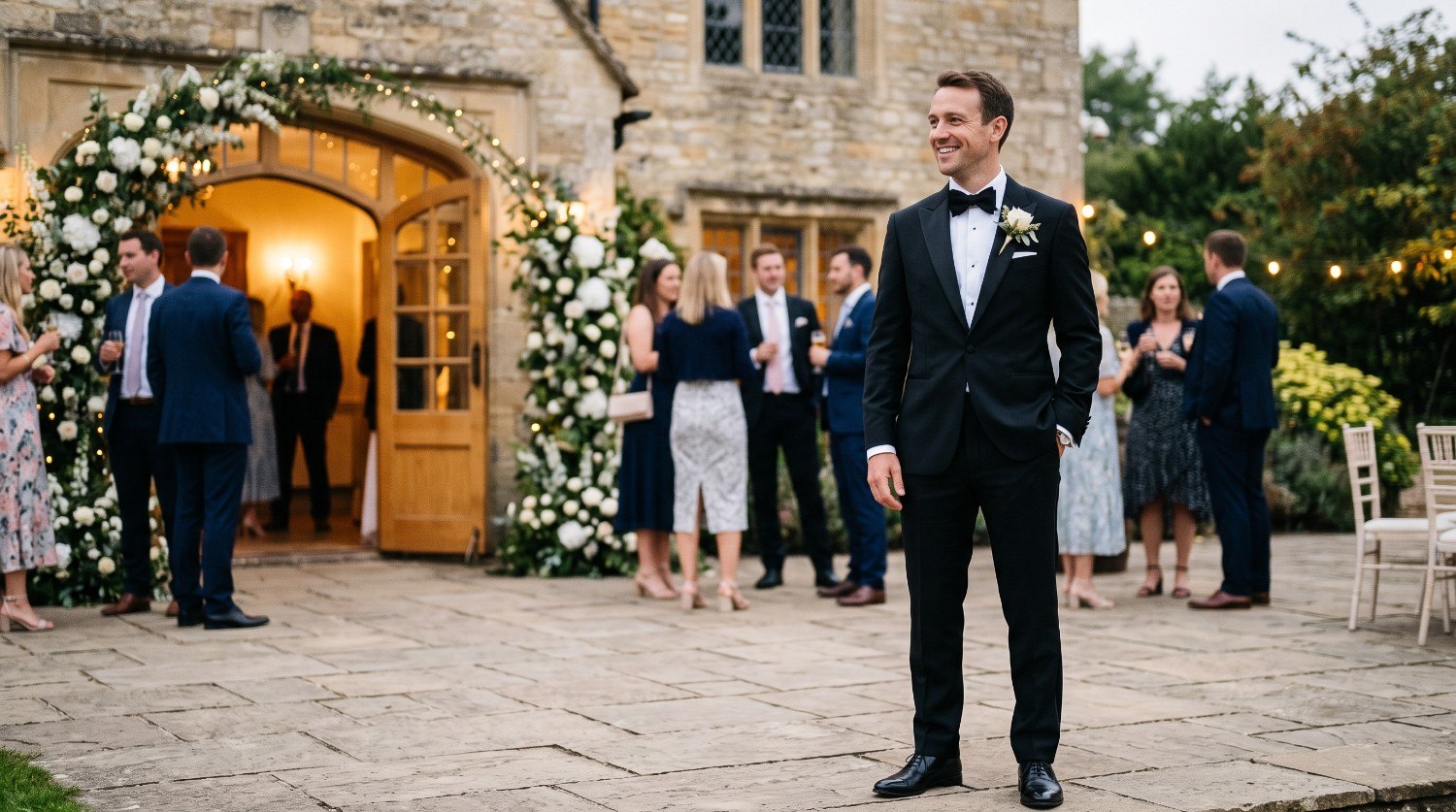
Choosing wedding tuxedos is not simply about wearing black. The right choice should match the formality of your wedding, the setting, your body proportions, and the version of yourself you want to see in your wedding photographs years from now.
Wedding tuxedos can be traditional, understated, or expressive. You do not have to choose the most unusual outfit to stand out as the groom. Often, a considered combination of fit, colour, and a few personal details makes the strongest impression.
This guide will help you narrow down your choices without getting lost in every fabric, lapel, and accessory option.
How Do You Choose a Wedding Tuxedo?
Start with the wedding dress code and time of day. Then choose a style that reflects your preferences, shortlist suitable colours, and check the fit. Set a budget for the complete outfit, coordinate with your partner, and confirm an ordering schedule that leaves time for adjustments.
The aim is to choose an outfit that suits both the celebration and the person wearing it.
1. Start With the Wedding Dress Code
Your dress code sets the level of formality your tuxedo needs to meet. Personalisation comes next.
For a traditional black-tie wedding, a black or midnight-blue tuxedo is a dependable starting point. Formal details such as silk-faced lapels, matching formal trousers, a white formal shirt, and a black bow tie distinguish it from an ordinary dark suit.
For a formal evening wedding without an explicit black-tie requirement, a tuxedo may still be appropriate. Consider how it fits with your partner’s outfit, the ceremony, and what you have asked guests to wear.
A relaxed daytime, beach, or garden wedding may call for a suit instead. The location alone does not decide this: a beach celebration can be formal, and a hotel wedding can be relaxed.
If you are still deciding which option suits your celebration, read our guide to tuxedo vs. suit for a wedding.
Before choosing a design, establish:
- The dress code.
- The ceremony and reception times.
- Whether you will be indoors, outdoors, or both.
- The expected temperature.
- The level of formality you and your partner want.
2. Choose a Style That Feels Like You
A wedding tuxedo should feel like a deliberate choice, not a costume. Start with how you want to present yourself, rather than copying an entire outfit from a photograph.
If You Prefer a Traditional, Understated Look
Focus on a classic silhouette, black or midnight-blue cloth, and restrained accessories. A peak or shawl lapel gives you room to express a preference without changing the overall formality.
This direction suits a groom who wants the outfit to support the occasion rather than become its main talking point.
If You Want Something Modern but Formal
Look for balanced proportions and clean lines rather than simply choosing the tightest cut. A well-proportioned lapel, neatly fitted trousers, and a subtle personal detail can make a traditional tuxedo feel individual.
Midnight blue is worth considering if you like dark formalwear but want an alternative to black.
If You Enjoy a More Expressive Look
Choose one feature to lead the outfit. That might be a velvet dinner jacket, an ivory jacket, or a distinctive texture, provided it works with the wedding’s dress code.
Keep the other details quieter. A statement jacket, patterned shirt, colourful bow tie, and bold shoes can compete with one another rather than form a coherent outfit.
If You Are Unsure About Your Style
Save three outfit photographs you like and identify what they share. Is it the colour, the jacket shape, the simplicity, or the contrast between the jacket and trousers?
You do not need to know tailoring terminology. Being able to explain what you like and dislike gives a stylist a useful starting point.
These are preferences, not fixed categories. You can favour traditional clothing and still want one personal detail for your wedding.
3. Match the Colour to the Celebration
Colour should work with the formality, setting, and season. It does not need to match every element of the wedding palette.
Use the following options as a starting point:
| Wedding setting or preference | Options to consider | Main consideration |
|---|---|---|
| Traditional black-tie evening wedding | Black or midnight blue | Keep the overall styling consistent with black tie. |
| Formal wedding with subtle individuality | Midnight blue | Compare the actual fabric, since blue shades vary. |
| Warm-weather formal evening celebration | Ivory or white dinner jacket with black formal trousers | Confirm that the look suits the dress code. |
| Autumn or winter evening celebration with creative styling | Dark velvet dinner jacket | Consider warmth as well as appearance. |
| Relaxed daytime wedding | A suit may be more suitable | Decide on formality before choosing a tuxedo colour. |
Black offers a familiar, consistent foundation. Midnight blue provides a subtle alternative, while an ivory dinner jacket creates a much stronger contrast.
Velvet adds depth through its texture, but it also changes how the outfit feels and wears. Choose it because it suits the celebration, not simply because the wedding takes place in winter.
For more inspiration, explore our guide to wedding tuxedo colours.
4. Choose the Lapel Without Overcomplicating It
The lapel helps shape the character of your jacket. For this first decision, focus on the overall effect.
Peak lapels have upward-pointing tips and create a more angular appearance. They are a traditional formalwear option for grooms who prefer a defined silhouette.
Shawl lapels have a continuous rounded edge. They are also a traditional dinner-jacket choice and suit grooms who prefer a smoother, simpler line.
Notch lapels are more closely associated with suits. If your aim is a traditional black-tie outfit, a peak or shawl lapel is the clearer choice.
Neither peak nor shawl is automatically best for every groom. Compare the lapel width with the jacket’s proportions and your own preferences instead of choosing from a detail photograph alone.
5. Prioritise Fit Before Decorative Details
The finest fabric or most interesting colour cannot compensate for poor fit. Your jacket should sit cleanly at the shoulders and close without obvious strain, while allowing you to move naturally.
At a fitting, check the complete outfit rather than assessing the jacket on its own.
- Shoulders and collar: Look for a clean line without obvious collapsing, pulling, or a gap behind the neck.
- Chest and waist: The jacket should close without pronounced tension around the fastening.
- Jacket length: Check the balance between your torso and legs in a full-length mirror.
- Sleeves: A small amount of shirt cuff should remain visible.
- Trousers: Check the waist, seat, and length with your intended shoes.
A narrow fit is not necessarily a good fit. Fabric needs enough room to accommodate sitting, walking, and reaching. Removing too much room can create pulling that becomes especially visible in photographs.
Ordering Your Wedding Tuxedo Online? Start With Your Fit Questions.
Talk to our team about measurements, your preferred fit, and any concerns before you order. Get online guidance to help you understand the next steps for your made-to-measure tuxedo.
Discuss Your Fit With Our TeamA Practical Fitting Check
Wear the shirt and shoes you intend to use on the day. Stand naturally, sit down, and move your arms before judging the result. An outfit that looks right only when you hold a particular pose still needs attention.
Customisation can help you address both proportions and personal preferences. When exploring custom wedding tuxedos, consider the cut and measurements alongside choices such as lapels, lining, and finishing details. Ask which adjustments are available for your selected design.
6. Choose Fabric for the Conditions You Will Actually Experience
Think about the full wedding day, not just the temperature inside the reception venue.
You may be outdoors for photographs, waiting before the ceremony, or moving between locations. Those periods matter when choosing fabric and construction.
Wool is a useful starting point, but the fibre name alone does not tell you how warm a tuxedo will be. Fabric weight, weave, lining, and jacket construction also affect how it wears.
For warm conditions, ask about lighter fabrics and breathable construction. For cooler celebrations, a heavier cloth or velvet jacket may be appropriate.
Consider the trade-off: a fabric chosen mainly for its rich texture may be warmer than you want, while a very light fabric may not have the structure you prefer. Ask to compare samples where possible.
7. Set a Budget for the Complete Outfit
Decide what you can spend before becoming attached to a particular design.
Your budget should account for more than the jacket and trousers. Include the shirt, shoes, bow tie, any waist covering, accessories, and possible adjustments. Confirm delivery charges and any other applicable costs before ordering.
If the total is higher than expected, reconsider decorative extras before compromising on fit or essential outfit pieces.
It is also worth thinking about future use. A restrained tuxedo may suit more formal occasions after the wedding, while a distinctive dinner jacket may be a choice you value mainly for this celebration. Neither is wrong, but the distinction can help you decide where to spend.
8. Complete the Look With Consistent Accessories
Accessories should reinforce the formality of your tuxedo rather than pull it in different directions.
For a traditional look, start with:
- A white formal shirt suitable for a tuxedo.
- A black bow tie.
- Appropriate black formal shoes.
- Black socks that cover the ankle when seated.
- A white pocket square.
- Cufflinks and shirt studs where the shirt requires them.
With a traditional single-breasted tuxedo, discuss whether a formal waistcoat or cummerbund is appropriate for the outfit.
Choose these pieces together. The shirt front, collar, fastening, and accessories need to work as a set. Trying on the complete outfit also helps you spot missing pieces before the wedding week.
9. Coordinate With Your Partner and Groomsmen
The groom should look connected to the wedding party without needing to be identical to everyone else.
You can distinguish your outfit through a boutonniere, lapel shape, waistcoat, or dinner jacket. A small difference may be enough; you do not need a contrasting colour to make your role clear.
Keep the overall formality consistent. If you wear a tuxedo while your groomsmen wear suits, make that an intentional wedding-party choice rather than a last-minute mismatch.
With your partner, discuss the overall mood, formality, and complementary colours. Your outfit does not have to match their clothing exactly, but the two should look as though they belong at the same celebration.
10. Confirm Your Ordering and Fitting Schedule
Work backwards from the wedding date. Allow time for style decisions, measurements, production, delivery, a complete try-on, and any necessary adjustments.
Do not assume that a production estimate covers the entire process. Ask when measurements must be finalised, when the outfit is expected to arrive, and what happens if alterations are needed.
For a custom groom tuxedo, confirm the schedule for your particular design and destination before placing the order.
Keep the following ready for your consultation:
- Wedding date and venue.
- Dress code and ceremony time.
- Your outfit budget.
- A few inspiration photographs.
- Relevant wedding-party colours.
- Any fit concerns or previous tailoring difficulties.
Try everything on as soon as it arrives. Waiting until the wedding week removes time that could otherwise be used to resolve a problem.
Your Final Wedding Tuxedo Checklist
Before committing to an outfit, make sure you can answer these questions:
- Formality: Does it suit our dress code and ceremony time?
- Personal style: Can I explain why this look feels right for me?
- Colour: Have I narrowed the choice to one or two suitable options?
- Fit: Have I checked proportions and movement, not just size?
- Budget: Does the total include the complete outfit and potential adjustments?
- Coordination: Does it work with my partner and wedding party?
- Timing: Is there a confirmed schedule with room for a final fitting?
You do not need every detail decided before speaking to a stylist. A clear shortlist, a realistic budget, and an understanding of the occasion are enough to make that conversation productive.
Still Deciding Which Wedding Tuxedo Is Right for You?
Share your wedding date, venue, dress code, and a few looks you like. Our team will help you narrow down colours, fabrics, and styling details through a free online consultation.
Book Your Free Online Style Consultation
