
First Order Discount: 10% OFF Sitewide — Use Code U5P8JPTZ

Perfect Fit 40x40@2x
1. Choose Style

Select your suit you like to order.

Customize 40x40 Copy@2x
2. Pick Customizations

Select lapel style, pocket style, buttons, linings, monogram etc...

Get Measured 40x40@2x
3. Get Measured ⓘ

Follow our measurement guide to enter correct size in customizer.

Shipping
4. Receive Suit

Get Delivered at Doorstep

Perfect Fit 40x40@2x
1. Choose Style

Select Style

Customize 40x40 Copy@2x
2. Customizable

Customize Your Suit

Get Measured 40x40@2x
3. Get Measured

Follow Measurement Guide

Shipping
4. Receive Suit

Get Delivered at Doorstep

The Complete Guide to the Pinstripe Suit

What Is Pinstripe Suit

Everything you need to know about one of menswear’s most powerful patterns. Its history, its rules, its fabric types, where to wear it, and how to wear it without looking like you stepped out of a gangster film.

What Exactly Is a Pinstripe Suit?

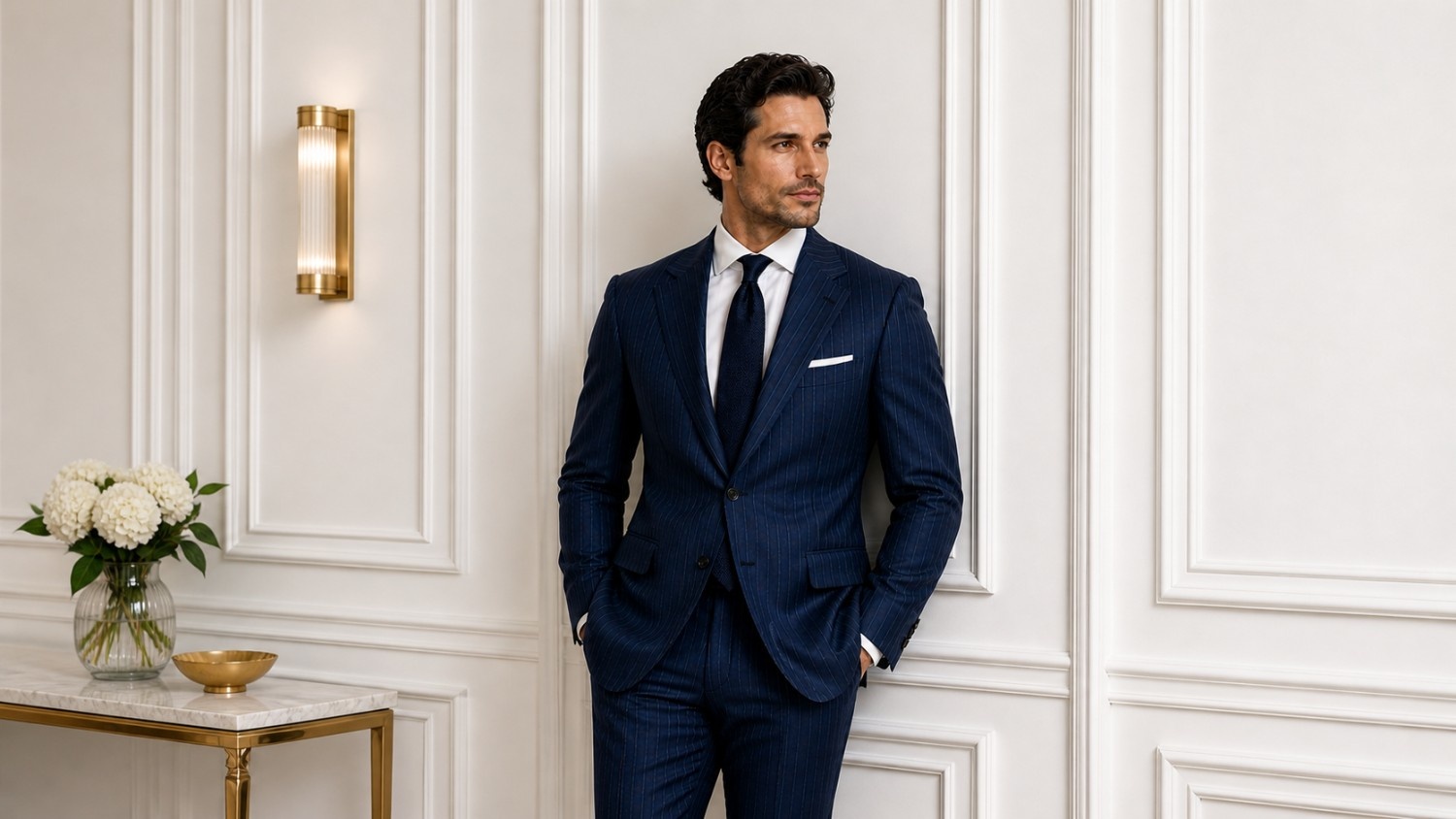
A pinstripe suit is a tailored two or three-piece suit made from fabric woven with very thin vertical lines running from the shoulder down to the hem. These lines, called pinstripes, are so fine they resemble the pointed tip of a pin, which is exactly where the name comes from.

Unlike chalk stripes or pencil stripes, true pinstripes are the thinnest category in the world of striped suiting. They typically measure no wider than 1/18 of an inch and are most commonly seen in dark navy or charcoal grey base cloths, where the contrast between the ground and the stripe creates a sharp, controlled visual effect.

The defining characteristic of a pinstripe suit is the way those vertical lines interact with the body. They draw the eye upward along the figure, creating an illusion of height and slimness. This is not an accident of design. It was a deliberate choice from the very beginning, used to project authority, precision, and a certain kind of formidable confidence.

“Wear a pinstripe well, and you look like you own the room. Wear it badly, and you are simply a prop.”

The pattern itself can appear in two distinct forms: woven stripes, where the stripe is literally part of the fabric construction, and printed stripes, which are applied after weaving. Woven stripes are always the superior option. They catch light differently at various angles, hold their definition through years of wear, and have a subtle three-dimensional quality that printed versions simply cannot replicate.

Pinstripe Suit Defination


Pinstripe Suit Defination

A Rich and Surprisingly Complicated History

Few suit patterns carry as much historical weight as the pinstripe. Its story is not a simple, linear progression from one respectable institution to another. It is the story of a pattern that has been claimed by bankers, gangsters, politicians, and rock stars and somehow emerged from all of it looking perfectly distinguished.

The British Banking Origins

The pinstripe suit originated in 19th-century Britain, where it emerged as a symbol of formality and class distinction. Initially associated with bankers and financial institutions in London, pinstripes often served a surprisingly practical purpose. Unique stripe patterns, with varying widths and spacing, were woven into the trousers of bank employees to function as an early form of identification. You could tell at a glance which institution a man worked for simply by looking at his trousers. It was a uniform that did not look like a uniform.

Gangsters, Icons, and Global Spread

By the early 20th century, the full pinstripe suit had made its way across the Atlantic and taken on an entirely different set of associations. American gangsters of the 1920s and 1930s adopted it enthusiastically. Al Capone, Lucky Luciano, and the broader world of organized crime embraced the double-breasted pinstripe suit with a fervor that gave the pattern a simultaneous reputation for danger and elegance.

Then came the correction. Winston Churchill wore them with gravitas. Cary Grant wore them with effortless charm. By the mid-20th century, the pattern had firmly established itself as the uniform of those in power, finance, law, and politics on both sides of the Atlantic.

The 2008 Dip and the Return

The financial crisis of 2008 dealt a temporary but significant blow to the pinstripes’ reputation. Because it had become so closely associated with bankers and the culture of excess that preceded the crash, the pattern fell out of fashion almost overnight. A decade of slim cuts, minimal patterns, and deliberately understated tailoring followed.

Today, pinstripes are back with genuine momentum. You see them in boardrooms as you always did, but also at weddings, on runways, and styled with turtlenecks and chunky loafers. The pattern has proven resilient enough to absorb a decade of suspicion and re-emerge as a true classic rather than a relic.
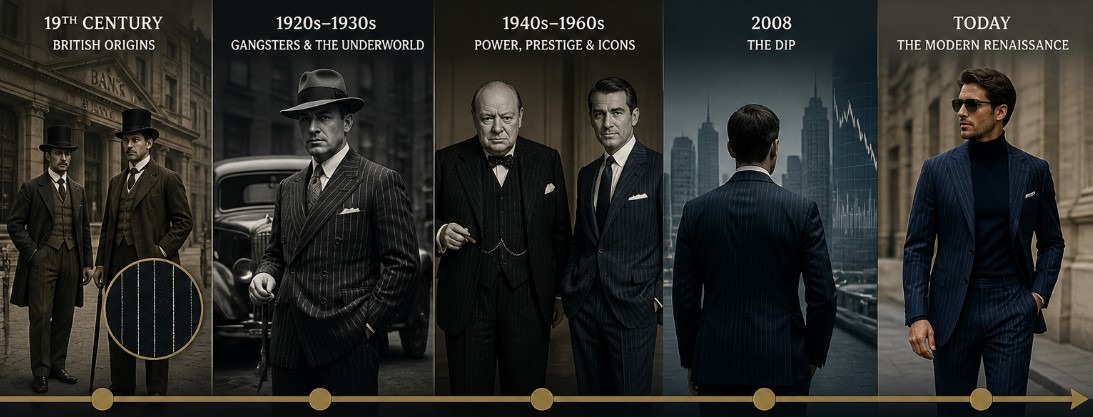
Pinstripe suit history


Pinstripe suit history

Understanding the Different Stripe Types

Not everything you hear called a pinstripe actually is one. The world of striped suiting has its own vocabulary, and knowing the difference between stripe types matters both aesthetically and in terms of the formality level you project.

Types Of Stripes


Types Of Stripes

Pinstripes

The true pinstripe is the thinnest and most formal of all stripe varieties. The line is so fine it genuinely resembles the head of a pin. You will find them almost exclusively on worsted wool fabrics, because the smooth, tightly woven surface is the only cloth that renders them with the precision they require. The spacing between stripes is usually tight and consistent, typically under an inch. On a dark navy or charcoal base, the effect is authoritative and unmistakably formal.

Chalk Stripes

Where pinstripes are precise, chalk stripes are expressive. The name comes from the appearance of a line drawn with tailor’s chalk, slightly irregular at the edges, softly textured, and wider than a true pinstripe. You find them most commonly on flannel, which is the ideal fabric for the pattern because flannel’s fuzzy texture amplifies the chalk-drawn quality of the stripe. A chalk stripe flannel suit is a distinctly different proposition from a pinstripe worsted, warmer in personality and more suited to autumn and winter wear.

Pencil Stripes

Pencil stripes fall between the two. Thicker than a pinstripe but more precise and sharper than a chalk stripe, they tend to sit at a slightly lower formality level than true pinstripes and work across a wider range of occasions. They are sometimes confused with pinstripes by those new to tailoring, and the distinction is not always critical in practice.

We customise all types of pinstripe suits. Make an appointment.

Fabric Types for Pinstripe Suits

The fabric you choose changes everything about a pinstripe suit. The same pattern in two different cloths produces two entirely different suits for different occasions, different seasons, and different messages attached to them.


Worsted Wool

The Classic Choice

Tightly woven, smooth surface. Holds the stripe definition perfectly. Year-round weight, breathes well. The default choice for business suiting.

Flannel

Autumn and Winter

Softly napped surface suited to chalk stripes. Warmer personality. Best for October through March. Drapes beautifully.

Tropical Wool

Hot Weather

Loosely woven, lightweight wool. Keeps structure and sharpness even in warm climates. The summer business suit choice.

Linen Blend

Casual Summer

Relaxed character. Stripe definition is softer. Works for warmer occasions but not a formal boardroom choice.

Mohair Blend

High Sheen

Slightly lustrous finish. Makes the stripe shimmer subtly. A bolder, more fashion-forward choice for those who know what they are doing.

Super 100s to 150s

Luxury Worsted

Finer yarn count. Softer hand feel with exceptional drape. The higher the Super number the more luxurious and delicate the cloth.

What Weight Should You Choose?

Fabric weight, measured in grams per metre, determines the suit’s suitability for different seasons and climates. A cloth in the 240 to 280 gram range is considered year round suiting for most temperate climates. Anything below 220 grams is a summer weight, and anything above 300 grams is a winter or cold climate cloth. For those in warmer regions, a 200 to 230 gram tropical worsted allows you to wear a pinstripe suit year round without suffering for it.

Fabric Rule of Thumb

For your first pinstripe suit, a 260 to 280 gram worsted wool in navy or charcoal is the safest investment. It will work across three seasons, render the stripe cleanly, and hold its shape through years of wear. Add flannel or tropical weight later once you understand how you want to wear the pattern.

Where to Wear a Pinstripe Suit

One of the most common questions about pinstripe suits is where they actually work. The honest answer is that they work in more places than most men assume, provided you know how to calibrate your styling for the occasion.

The Office 

The pinstripe’s natural habitat. Boardrooms, client meetings, presentations, and any environment where appearing authoritative matters. A navy or charcoal pinstripe with a white shirt and silk tie in this context is essentially unassailable.

Weddings

As a wedding guest, a well fitted pinstripe in navy reads as smart, considered, and stylish without upstaging the couple. Avoid very bold stripes at formal religious ceremonies. A subtle pinstripe in worsted wool with a white shirt and pocket square is a very respectable choice for almost any wedding dress code above casual.

Job Interviews

Tread carefully here. A pinstripe suit projects confidence and power, which can be a genuine advantage in senior positions but can read as arrogant if the role or culture does not expect it. For creative industries, startups, or junior positions, a solid navy or charcoal is safer. For senior finance, law, or executive roles, a pinstripe could actually work in your favour.

Formal Events

Pinstripes work at cocktail parties, charity dinners, and theatre nights. They are in the right formality zone for occasions that sit above business casual but below black tie. With the right accessories, a well-cut pinstripe can hold its own in these settings with considerable style.

Funerals

A striped suit at a funeral draws attention to itself in a way that can feel inappropriate. A solid dark navy or charcoal, or black if available, is a more considerate choice. The occasion calls for understated support rather than personal style expression.

Casual Days

This is where modern styling has opened new territory. Pairing a pinstripe jacket with dark jeans and a turtleneck, or wearing the full suit with a plain t-shirt and white trainers, is a legitimate contemporary approach. It requires confidence and a certain self awareness about your own style, but it works when executed thoughtfully.

The Do's and Don'ts of Wearing Pinstripes

Do this

  • Ensure the suit fits properly before anything else
  • Keep shirts solid or subtly textured
  • Maintain one pattern in the outfit at a time
  • Invest in quality leather shoes
  • Press the suit before wearing
  • Match stripe width to your body scale
  • Wear it with confidence and intention
  • Consider a pocket square for polish

Avoid this

  • Wearing a checked shirt with a striped suit
  • Over-accessorising with competing patterns
  • Wearing a baggy or ill-fitting pinstripe
  • Choosing very wide stripes for formal occasions
  • Wearing it to a funeral or deeply solemn event
  • Pairing with novelty socks that draw attention
  • Choosing a printed stripe over a woven one
  • Wearing the jacket alone with jeans at first

The pinstripe suit has survived two centuries, several major cultural reputations, a financial crisis, and a global pandemic. It has been claimed by every generation and given back to the next one looking exactly as relevant as before. That kind of longevity is not luck. It is the mark of something genuinely well designed, built around a principle that holds: that a vertical line running from shoulder to hem, rendered precisely in a quality cloth, makes almost any man look better than he did without it.

Buy one. Learn how it works on your body and in your life. Then, if you are anything like most men who discover real tailoring, it will not be your last.

 
My Cart
Categories